Photography by Edward C. Robison III
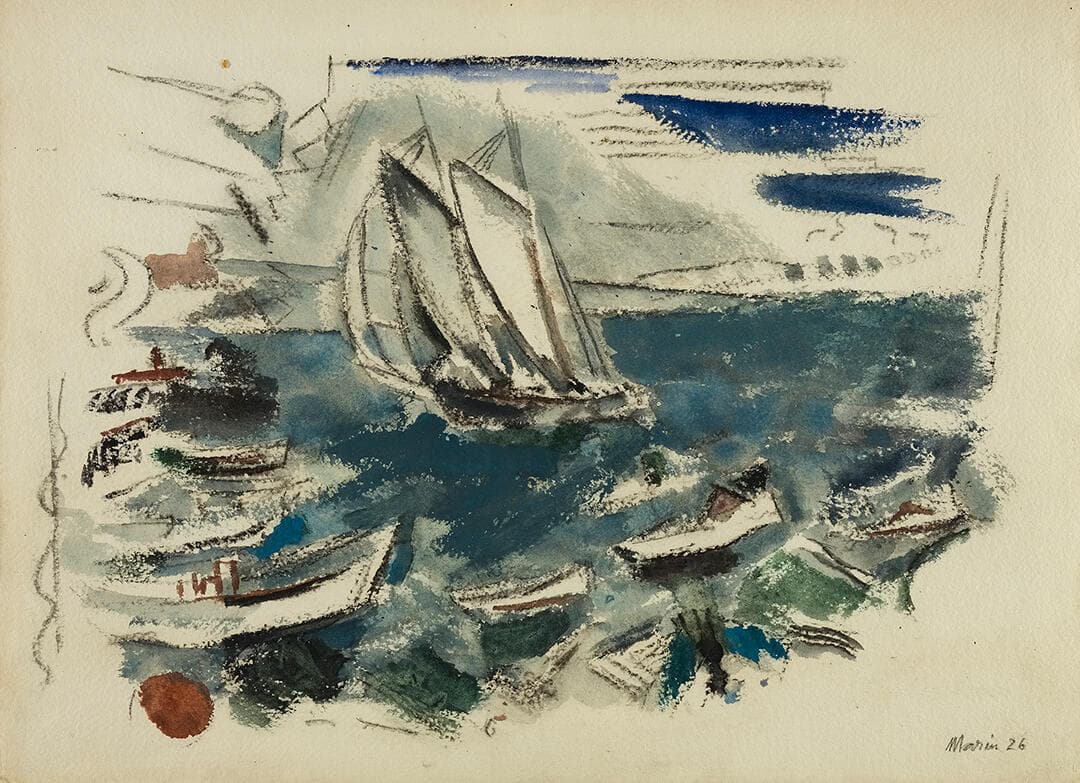
Lobster Smack
Lobster Smack has the animated quality often found in Marin’s watercolors of coastal Maine and New York City. He achieved the effect of movement through repetition of forms, such as the edge of the jib on the smack in the foreground, marking the boat’s swaying forward path in the water. Marin also abbreviated objects and parts of the landscape, obscuring spatial relationships to create dynamic imbalance. His watercolor technique varies from light washes of color in the sky to heavily pigmented areas below the boats.
Stieglitz exhibited Marin more than any other artist in his circle. He met the artist in 1909 and encouraged him to find his own style rather than produce Impressionistic scenes of Europe, such as Sestiere di Dorso Duro, for the American art market. Marin incorporated aspects of Cubism and Futurism with an approach to watercolor that Stieglitz believed represented a home–grown American form of Modernist expression.
This artwork's face covers about 102× the area of a tennis ball.Drawn to the same scale.